


Janovics Center for Screen and Performing Arts Studies is affiliated with the Faculty of Theater and Film at Babeș-Bolyai University. It aims to advance interdisciplinary research in the fields of performing and screen arts: theatre, performing arts, film, television and media. The center is dedicated to researching the dialogue of these arts with contemporary society. It supports projects that study reception in theatre and film; cultural consumption in the context of digitalization; theatre, film, television and digital media iconography; the relationship of film, television and theater with new media; digital distribution; and theatre and visual anthropology. It also supports projects that approach the institutional system in culture, legislation on the operation and financing of entertainment and film institutions, and sustainable cultural management in the field.
The Janovics Center for Screen and Performing Arts Studies takes over and continues, at a superior level of quality, the activity of the “Vlad Mugur” Center for Research and Creation in Theater, Film and Media, started in 2007. CCCTFM Vlad Mugur has so far hosted several working groups on history, theory, and praxis in the fields of theater, film, and media, has developed impactful research, has consistently organized high-visibility international conferences, published collective and individual volumes hosted by prestigious publishing houses in the country and abroad, and has also edited the biannual scholarly journal Studia UBB Dramatica. The restructuring and renaming comes to respond to the members’ desire to give their research a wider international resonance, emphasizing both its interdisciplinary and multicultural character.
The center takes the name of an actor, film and theatre director from Cluj. Jenő Janovics was a pioneer of film production in the region, making his first film, The Yellow Foal, in 1913 and then starting the first local film studios, Corvina (1915) and Transsylvania Film (1917).
Leadership: The Center is headed by Miruna Runcan (Professor of Theatre Studies) and Constantin Parvulescu (Associate Professor of Film and Media studies).
Founding Members
Horea Avram — Associate Professor of Film and Media Studies
Anna Batori — Associate Professor of Film and Media Studies
Ana Grgic — Associate Professor of Film and Media Studies
Anca Hațiegan — Associate Professor of Theatre Studies
Liviu Malița — Professor of Theatre Studies
Cristina Modreanu — Researcher in Theatre Studies
Laura Pavel — Professor of Theatre Studies
Andrea Tompa — Associate Professor of Theatre Studies
Claudiu Turcuș — Associate Professor of Film and Media Studies

Klaus Obermaier and Ars Electronica Futurelab, „Apparition” (2004-2013)
Leadership
Miruna Runcan — Professor of Theatre Studies
Constantin Parvulescu — Associate Professor of Film and Media Studies
Members
Horea Avram — Associate Professor of Film and Media Studies
Boglárka Farkas — PhD. Candidate in Film and Media Studies
Ana Grgic — Associate Professor of Film and Media Studies
Anca Hațiegan — Associate Professor of Theatre Studies
Liviu Malița — Professor of Theatre Studies
Laura Pavel — Professor of Theatre Studies
Raul Ștef — PhD. Candidate in Film and Media Studies
Andrea Tompa — Associate Professor of Theatre Studies
Lucian Țion — Senior Lecturer in Film and Media Studies
Claudiu Turcuș — Associate Professor of Film and Media Studies
Andrea Virginás — Associate Professor of Film and Media Studies
Ilinca Todoruț — Assistant Professor in Theatre Studies
Research Grants
2022-2024: Exploratory Research Grant (PN-III-P4-PCE2021-0141)
Project title: Screening Romanian Social Transformations, 1990-2021
Principal Investigator: Constantin Parvulescu
Website: https://screensocial.granturi.ubbcluj.ro
2022-2024: Young Teams Research Project (PN-III-P1-1.1-TE2021-0613)
Project title: Cultural Traumas in Minor European Cinemas
Principal Investigator: Andrea Vriginas
Website: https://culttraumacinema.wordpress.com
2023 – 2027: Volkswagen Stiftung Grant
Project title: Aging and Gender in European Cinema:
Participants: Goethe Universität Frankfurt, Universitá degli Studi di Udine, King’s College London, Université Paris Sorbonne Nouvelle, Universitatea Babeș-Bolyai.
Participating Center Scholars: Andrea Vriginas and Boglarka Farkas
Website: https://age-c.eu
2022 – 2025: AFCN Grant
Project title: The Multimedia Dictionary of the Romanian Theatre
Principal Investigators: Cristina Modreanu and Miruna Runcan
Website: www.dmtr.ro
2025
· Grgic, Ana. Early Cinema, Modernity and Visual Culture: The Imaginary of the Balkans. Taylor & Francis, 2025.
· Parvulescu, Constantin, and Claudiu Turcuș. Romanian Capitalism on Film. Edinburgh University Press, 2025.
· Todoruț, Ilinca Tamara. „Roma Feminist Practice: An annotated interview with Giuvlipen theatre artists Arhanghela, Mihaela Drăgan, Nicoleta Ghiță, and Zita Moldovan.” Revista Transilvania 3 (2025).
· Borza, Cosmin, and Claudiu Turcuș. „Therapy for the shock: 19th-century storytelling and post-communist emigration.” Journal of Postcolonial Writing 61, no. 4 (2025): 523-537.
· Țion, Lucian. Romanian and Chinese Cinemas: Socialist Affect and Cultural Politics from Maoism to the New Waves. Edinburgh University Press, 2025.
· Virginás, Andrea. „Empowering Archetypes: Middle-Aged ‘Eco-Warrior’ Women in Small National Ecocinematic Landscapes.” Ekphrasis. Images, Cinema, Theory, Media 33, no. 1 (2025): 85-102.
· Virginás, Andrea. „Infecting a Body or Infecting on Screen.” Hungarian Journal of English and American Studies (HJEAS) 31, no. 1 (2025): 168-195.
2024
· Grgić, Ana. „Southeast Asian Shapeshifters in the age of streaming: minor transnationalism, horror and reimagining MUBI in Malaysia.” Continuum 38.5 (2024): 626-646.
· Grgić, Ana, and Fabio Bego. „Useful Bodies, Socialist Commodification and Everyday Culture: Promoting Albanian and Yugoslav Industrial Production Through Non-Fiction Films.” Studies in Eastern European Cinema 15.3 (2024): 324-343.
· Grgic, Ana, and Johan Höglund. „Special issue introduction: representation of diasporic food cultures.” Food, Culture & Society 27.2 (2024): 293-296.
· Grgić, Ana, and Marian Tutui. „The voices of the nations.” The Routledge Companion to Global Film Music in the Early Sound Era (2024).
· Grgić, Ana, and Marian Țuțui. „Who is Singing over there? The Potpourri of Multiple Voices in Early Sound Cinema of the Balkans.” The Routledge Companion to Global Film Music in the Early Sound Era. Routledge, 2024. 332-350.
· Grgić, Ana. „6. Industrial Ruins, Malaise, and Ambivalent Nostalgia.” Visual Culture of Post-Industrial Europe (2024): 171.
· Hațiegan, Anca. „Theatricality and Totalitarianism. Case Study: The Black Envelope (1986) by Norman Manea.” Trimarium 1, no. 5 (2024): 117-135.
· Hațiegan, Anca. „Liviu Ciulei and The Last Ones: Between Personal Trauma, Psychodrama, and Collective Drama.” Studia Universitatis Babes-Bolyai-Dramatica 69, no. 1 (2024): 77-97.
· Hațiegan, Anca. Ciulei și spectrul Tatălui. O psihobiografie Bucharest: Litera, 2024.
· Parvulescu, Constantin, and Lucian Georgescu. „Narrating entertainment streaming in Europe.” Journal of Digital Media & Policy 15, no. 2 (2024): 141-154.
· Runcan, Miruna. Damen vals: voci feminine în critica de teatru a secolului XX. Tracus Arte, 2024.
· Runcan, Miruna. Damen vals: voci feminine în critica de teatru a secolului XX. Tracus Arte, 2024.
· Todoruț, Ilinca. „Mourning the Factory: Artistic and social imaginaries in the neoliberal city.” Performance Research 29, no. 2 (2024): 21-27.
· Todorut, Ilinca. “How to Lose a Guy in Ten Wars.” Introduction to Opheliamachine by Magda Romanska, 1-8. London: Bloomsbury, 2024.
· Todoruț, Ilinca Tamara. „Applying Brecht’s Anti-Spectacular Approach to Staging Fascism.” In Dramaturgy and History, pp. 110-115. Routledge, 2024.
· Todorut, Ilinca. “Lockdown Theatres of Sadness: Case studies of precarity in artistic work.” Performance Research 28, no.5 (2024): 105-113.
· Todorut, Ilinca. “Mobilizing Workers Poetry: A Pedagogical Journal.” TDR: The Drama Review 68, no. 1 (2024): 170–84. https://doi.org/10.1017/S1054204323000539.
· Borza, Cosmin, and Claudiu Turcuș. „Tragicomedia Occidentului: emigrația economică în romanele și filmele românești din anii’90.” Revista Transilvania 5 (2024).
· Borza, Cosmin, and Claudiu Turcuș. „Tragicomedia Occidentului: emigrația economică în romanele și filmele românești din anii’90.” Revista Transilvania 5 (2024).
· Țion, Lucian. „Early Hollywood’s Social Awareness Films and Contemporary Cinema: The Locarno International Film Festival, 2024.” Film Criticism 48, no. 2 (2024).
· Virginás, Andrea. „Communicative Generations between Cold War Trauma and HBO-Type ‘Televisuality’: Entering the Paratextual Flow of Chernobyl, The Informant, and Spy/Master.” Eastern European Screen Studies (2024): 1-19.
2023
· Farkas, Boglárka Angéla. „Pandora’s Myth and Cultural Trauma in Alex Garland’s Ex Machina.” Acta Universitatis Sapientiae, Film and Media Studies 24 (2023): 203-216.
· Hațiegan, Anca. “The Avant-garde and Independence: The Case of Romania.” In A Lexicon of the Central-Eastern European Interwar Theatre Avant-garde, edited by Dariusz Kosiński, 53-62. Warsaw and Aberystwyth: Instytut Teatralny im. Zbigniewa Raszewskiego and Performance Research Books, 2023. ISBN 978-83-67682-17-6.
· Hațiegan, Anca. “The December 1989 Revolution in Post-Communist Romanian Drama.” In Language of the Revolution: The Discourse of Anti-Communist Movements in the “Eastern Bloc” Countries: Case Studies, edited by Eugen Wohl and Elena Păcurar, 265-288. London: Palgrave Macmillan, 2023.
· Hațiegan, Anca. “Theatre of the Nation: Romanian Historical and Allegorical Drama Before the First World War.” Trimarium: The History and Literature of Central and Eastern European Countries, 1, no. 1 (2023): 312-331. https://doi.org/10.55159/tri.2023.0101.13.
· Modreanu, Cristina. “Crossdressing as Resistance in Communist Romania: The Case of Miluță Gheorghiu.” European Journal of Theatre and Performance, 6 (2023): 344-359.
· Modreanu, Cristina. “Gianina Cărbunariu, Director-Playwright.” In The Routledge Companion to Contemporary European Theatre and Performance, edited by Aneta Mancewicz and Ralf Remshardt, 531-536. Abingdon – New York: Routledge, 2023.
· Modreanu, Cristina. “If you had only spoken…Counter-narratives and Marginalized Histories of Women on the German Stage in Romania, before and after 1989.” Critical Stages (IATC webjournal), 27 (2023).
· Pavel, Laura et. al. Dicționarul cronologic al romanului românesc de la origini până în 2000, vol. I-II. Rev. ed. Cluj-Napoca: Presa Universitară Clujeană, 2023. ISBN 978-606-37-1905-9, (vol. I) 978-606-37-1906-6, (vol. II).
· Pavel, Laura, Deliu, Ana-Maria and Paul Mihai Paraschiv. “What is Post-Criticism? Reconstructive Interpretive Strategies.” Metacritic Journal for Comparative Studies and Theory, 9.2 (2023): 4-8. https://doi.org/10.24193/mjcst.2023.16.01.
· Țion, Lucian. „Tragedy after Farce: Family Relations in Capitalism and the Postsocialist Generational Gap in Radu Jude’s Everybody in Our Family.” Revista Transilvania (2023).
· Virginás, Andrea. “Media Borders in a Post-Media Age: The Historical and Conceptual Co-evolution of Cinema, Television, Video, and Computer Screens.” In The Palgrave Handbook of Intermediality, edited by Jørgen Bruhn, Asun
López-Varela Azcárate, Miriam de Paiva Vieira, 979-998. London: Palgrave Macmillan, 2023.
· Virginás, Andrea. “Mediated Remembering of Having Been Traumatized Collectively in Recent Hungarian Historical Films: Transmediating Analogue Photography in Post Mortem (2020) and Natural Light (2021).” Ekphrasis. Images, Cinema, Theory, Media, 29, no. 1 (2023): 25-46.
2022
· Constantin, Parvulescu, ”The critical Innovation Discourse of Small VODs: The Case of The Death of Mr. Lăzărescu on Cinepub. Images vol. XXXII, no. 41. Poznan 2022. Adam Mickiewicz University PressLaura Pavel, Ionesco. Antilumea unui sceptic, ediţie revăzută şi adăugită, Cluj, Ed. Şcoala Ardeleană, 2022.
· Modreanu, Cristina. Teatrul ca rezistență. Oameni de treatru în arhivele Securității. Polirom 2022.
· Parvulescu, Constantin., & Copilaș, E. (2022). Bottom-up Content Convergence Phenomena in Socialist Cultural Economies: The Case of Premodern Story Universes of Romanian Film and Music. East European Politics and Societies.
· Parvulescu, Constantin. „Romanian Film for the World: the Cultural Embedding of an Independent vod”, Studies in World Cinema 2, 1-2 (2022): 142-160, doi:
· Parvulescu, Constantin. „Finance Film on Must-See Lists: A Tale of Positivization.” Acta Universitatis Sapientiae, Film and Media Studies 21, no. 1: 184-199.
· Țion, Lucian. 2022. „The Relationship of History to the Present: Romanian Nationalism in the Films of Radu Jude.” Cinéaste 47, no. 4 (September): 30-34.
· Tion, Lucian. 2022. ”The Socialist Leader in Film: Sergiu Nicolaescu’s Hot Days in Romania and Post-Maoist China.” Comparative Literature Studies (Urbana) 59, no. 3 (August): 468-486.
· Anca Hațiegan. „Nacionalista kiszorítósdi: Francesca Rozan esete (Nationality in Art: The Case of Francesca Rozan).” Szinhaz.net. No. 22, March (2022): 20-24.
· Ana Grgić, Early Cinema, Modernity and Visual Culture: The Imaginary of the Balkans. Amsterdam: Amsterdam University Press, 2021.
2021
· Constantin Parvulescu and Jan Hanzlik. „The Peripheralization of East-Central European Film Cultures on VOD Platforms.” Iluminace. Vol. 33, Iss. 2, (2021): 5-25.
· Horea Avram, Perspectiva negociabilă. Eseuri și comentarii despre practici artistice actuale. [Negotiable perspective. Essays and Comments on Contemporary Artistic Practices]. Bucharest: Eikon Press, 2021.
· Ana Grgić, La désintégration et la résurrection de l’image-matière : pour une philosophie de la restauration cinématographique, Presa Universitară Clujeană, 2021.
· Laura Pavel, Personaje ale teoriei, fiinţe ale ficţiunii (Personae of Theory, Beings of Fiction), Iaşi: Institutul European, 2021.
· Miruna Runcan, Teatru în diorame. Discursul criticii de teatru în comunism. Viscolul 1978-1989, (Theatre Criticism Discourses in Communist Era – 1987-1989), București, Editura Tracus Arte, 2021.
· Ana Grgić, “Dialogical kinesis: Edison and the “print” appearance of Blacksmiths in the Balkans”, Early Popular Visual Culture, May, 2021. DOI: 10.1080/17460654.2021.1914702
· Constantin Parvulescu, “The Political and Economic Intervention of Non-Fiction Money Literacy Film in the Post-2008 Era,” Canadian Journal of Film Studies, · (2021) 30:1, 49-71 DOI: 10.3138/cjfs-2020-0034
· Constantin Parvulescu & Claudiu Turcuș, “Afterlives of Romanian socialist-era historical film: reruns, story universes, reception,” Canadian Slavonic Papers, (2021) 63:1-2, 50-71, DOI: 10.1080/00085006.2021.1915527
· Cristina Modreanu, “National Identity as inflammable material (Identitatea Națională ca material explozobil)”, Scena.ro online · https://revistascena.ro/category/editorial/
2025 Janovics Award Winners Announcement
The Janovics Center Award for Outstanding Humanities Research in Transnational Film and Theatre Studies is yearly awarded to publications that advance transnational research in the fields of film and theatre studies and employ innovative methods in the humanities. The Jury awarding these works was composed of Professors Lucian Georgescu, National University of Theatre and Film “I.L. Caragiale” Bucharest; Angelos Koutsourakis, University of Leeds; and Boglárka Angéla Farkas, Babes-Bolyai University, Cluj.
The Jury decided to offer the following awards:
BEST BOOK IN FILM STUDIES 2025: Ori Levin, Celluloid Babel: Pursuing a Universal Language in Cinema (Suny Series, Horizons of Cinema, 2025).
Jury accolade: Celluloid Babel offers an excellent exploration of an old, almost forgotten idea – the dream of cinema as a universal language – in a captivating monograph, which is transnational in scope (as it investigates the cosmopolitan aspect of theorizing film at the beginning of the 20th century) and remarkably links these past debates to present media ecologies (the universal language ideal being set in parallel with present-day phenomena, such as the on-demand personalized media and the crisis of truth in 21st). In light of the detailed research, well-established arguments and exceptional quality of academic writing that permeate Levin’s monograph, the Jury believes that Celluloid Babel could soon become a fundamental reference in film studies, considering that it can be equally revelatory for those working in film education or film research, and for anyone interested in the (early) promises of the medium.
SPECIAL MENTION: Petar Mitric, The Co-production Landscape in Europe: From Eurimages to Netflix (Palgrave Macmillan, 2025)
Jury accolade: The Co-Production Landscape in Europe is a highly ambitious and relevant work with a piercing urgency, as it provides an exploration with regard to the current affairs of European co-productions. The topic is addressed via an impressive methodology that combines practice-based research with theoretical grounding. The scope of the monograph is inseparable from transnational aspects, and it is commendable that the author offers considerations that can be equally useful for those working in the field of production studies, but also for policymakers and practitioners. Importantly, the monograph places a notable emphasis on the role of the audience (a usually neglected factor in European cinema practices) and highlights the possibilities of audience design, which can further contribute to what the author convincingly conceptualizes as ‘an ideal European co-production’.
Best Article was not awarded this year.
The Janovics Center congratulates the authors and will organize book presentations and talks related to their work on May 22, 2026. Further details on the award and related events will be available on the Center’s website, under News and Events and on social media.
UPCOMING EVENT:
The Janovics Center Award for Outstanding Humanities Research in Transnational Film and Theatre Studies
∇ CALL FOR SUBMISSIONS (INFOPACK HERE)
2023 Award Winners Announcement
The Janovics Center Award for Outstanding Humanities Research in Transnational Film and Theatre Studies is yearly awarded to publications that advance transnational research in the fields of film and theatre studies and employ innovative methods in the humanities. The Juries awarding these works were composed of Professors Agnieszka Rasmus from the University of Lodz, Professor Francesco Pitassio from the University of Udine, and Constantin Parvulescu, director of the Janovics Center (for film studies); and Professor Andriej Moskwin from the University of Warsaw, Professor Ileana Marin from the University of Wasington, and Miruna Runcan, director of the Janovics Center (for theatre studies). The Juries decided to offer the following awards:
BEST BOOK of 2023: Exotic Cinema: Encounters with Cultural Difference in Contemporary Transnational Film by Daniela Berghahn, Edinburgh University Press, 2023.
The Jury commends the monograph as an outstanding example of transnational film studies research, which analyzes many films from various continents and regions of the globe. Berghahn’s meticulous scholarship, comprehensive writing, and well-constructed argument are praised for decentering concepts such as the exotic and exoticism, inviting readers to rethink them. The book moves away from the received wisdom of exoticism, too often coupled with orientalism and colonial power, and offers an original and insightful look at what the notion means today. With a profound understanding of the literature in her field, Berghahn offers a courageous critical reassessment of the aesthetic strategies and cultural value of exoticism against competing concepts describing cross-cultural encounters, such as orientalism, colonialism, primitivism, imperialism, and cultural appropriation. Her case studies are meticulously discussed and offer a multifaceted picture not just of individual films but also of their production context and reception.
BEST ARTICLE of 2023: “The Domestic Kitchen as Performance Space: The Female Artist vs the Housewife” by Athena Stourna, published in Critical Stages (2023).
The Jury considered that the article offers a complex perspective on the evolution of a cultural/ theatrical phenomenon, also addressing relevant issues concerning women’s artistic formulas of rethinking the cultural heritage by means of original and powerful – provocative and friendly at the same time – pieces of theatrical performance dedicated to a contemporary audience. The Jury appreciated Stourna’s profound analysis of the social, cultural, and political (both national and international) context of theatre productions, and the complex depiction of the impact of their aesthetic achievement.
The Jury also decided to offer a SPECIAL MENTION to the monograph A Critical History of Health Films in Central and Eastern Europe and Beyond by Victoria Shmidt and Karl Kaser. Routledge, 2023.
The Jury commends the novelty of the topic of the monograph and the relevance of the way in which it analyzes its primary material. Shmidt and Kaser’s effort originally approaches propaganda films about health from East-Central Europe as relevant contributions to understanding important transformations in global conceptions of governmentality. The monograph effectively addresses a substantial gap in the field and shifts away from usual bodies of work focused on Western countries’ institutions and film productions. By combining a wide range of methodologies, film analysis, the history of medicine, cultural anthropology, and political theory, it is exceptionally interdisciplinary. By looking at different actors involved in making health films, it shows complicated entanglements between the local and the global. This approach enriches our knowledge of the role cinema played in contributing to and exerting biopower, while giving full account of previously neglected areas. The case studies reveal early cinematic tools of “othering,” especially along the gender, class, and race spectrum.
The Janovics Center congratulates the authors and will organize book presentations and talks related to their work. Further details on the award and related events will be available on the Center’s website, under News and Events and on social media.
Cluj-Napoca, March 20, 2023. Constantin Parvulescu and Miruna Runcan
EVENT:
The Janovics Center Award for Outstanding Humanities Research in Transnational Film and Theatre Studies
The Janovics Center for Screen and Performing Arts Studies and the Faculty of Theatre and Film at Babes-Bolyai University invite submissions for their annual award for outstanding humanities research in transnational film and theatre studies. The award will be offered to contributions in the fields of film or theatre studies. The award consists of an invitation to give a talk at the Center and an honorarium.
What is awarded?
The Janovics Center is committed to supporting highly original research in screen and performing arts studies. Awarded are research articles, monographs, or edited collections published in 2023.1 They are expected to advance transnational research in the fields of film or theatre studies and employ a methodology that is specific to the humanities. Interdisciplinary approaches are very welcome.
Publications must be written in English. Monographs and edited collections must be published with an internationally recognized press by the Romanian Ministry of Research. See list! Articles are expected to be at least 6000-word long and indexed in one of the following databases: Scopus or Web of Science.
The Center offers two awards. One for a monograph or an edited collection – Invitation and a Euro 500 honorarium; and one for a research article – invitation and a Euro 300 honorarium.2 Previous awardees include: Agnieszka Rasmus, Hollywood Remakes of Iconic British Films: Class, Gender and Stardom (Edinburgh University Press), Rachel S. Harris and Dan Chyutin, Casting a Giant Shadow: The Transnational Shaping of Israeli Cinema (Indiana University Press); Andrea Virginás, Film Genres in Hungarian and Romanian Cinema: History, Theory, and Reception (Rowman and Littlefield/Lexington Books, Special Mention); Majeed Mohammed Midhin & David Clare “National Cultural history and Transnational Political Concerns in Rasha Fadhil’s ‘Ishtar in Baghdad’,” and Andrew Higson, „The Resilience of Popular National Cinemas in Europe.”
Who can participate?
Submissions from both emerging and experienced scholars are welcome. Authors must hold a PhD and be employed by a European university. The submitted publication cannot have more than two authors. In the case of two authors, at least one must fulfill the employment conditions mentioned above and the award will be split.
Deadline and Evaluation Process
The deadline for submissions is February 9, 2024. Results will be made public by March 23, 2024 on the Center’s Website. The award ceremony and talks will take place in May 2024. The Jury will include members of the Center and scholars in the fields of film and theatre studies.
How to submit your work?
We encourage electronic submissions in PDF or EPUB format. Electronic submissions should be sent to both Constantin Parvulescu constantin.parvulescu@ubbcluj.ro and Miruna Runcan daniela.gologan@ubbcluj.ro and should be accompanied by a cover letter (200-300 word). If not available in electronic format, hard copies and the cover letter should be mailed to the address below before the deadline.
Janovics Center for Screen and Performing Arts Studies
Faculty of Theatre and Film
Babes-Bolyai University
Str. Mihail Kogălniceanu nr. 4
400084, Cluj-Napoca, România.
Send queries to Constantin Parvulescu (film) constantin.parvulescu@ubbcluj.ro and Miruna Runcan (theatre) daniela.gologan@ubbcluj.ro.
We look forward to reading and awarding your work!
EVENT:
EVENT:
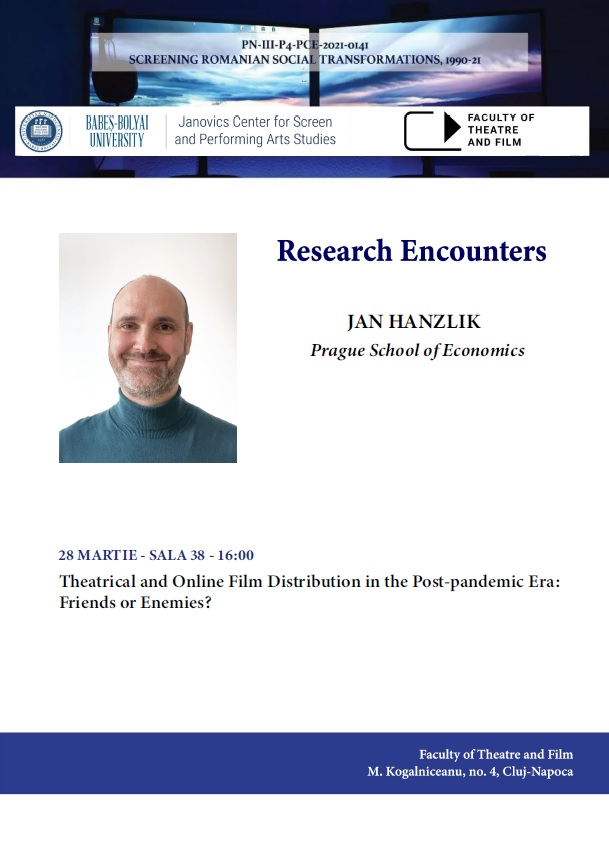
NEWS: Award Winners Announcement

The Janovics Center Award for Outstanding Humanities Research in Transnational Film and Theatre Studies is yearly awarded to publications that advance transnational research in the fields of film and theatre studies and employ innovative methods in the humanities. The Jury awarding these works was composed of Professors Rachel Harris, Florida Atlantic University; Andrew Higson, University of York; and Constantin Parvulescu, Babeș-Bolyai University (for film studies); and Jozefina Komporaly, University of the Arts: London; Beatrice Picon-Vallin, Centre National de la Recherche Scientifique, France; and Miruna Runcan, Babeș-Bolyai University (for theatre studies). The Jury decided to offer the following awards:
BEST BOOK of 2022: Hollywood Remakes of Iconic British Films: Class, Gender and Stardom (Edinburgh University Press, 2022) by Agnieszka Rasmus, University of Łódź, Poland.
The Jury regards the monograph as an excellent example of transnational film studies research. It commends its detailed scholarship, quality of writing, and carefully thought-out argument. One of the strengths of Rasmus’s monograph is the novelty of the topic, an examination of films made with substantial Hollywood involvement in the UK in the 1960s/1970s, and then remade as Hollywood films in the 2000s, thereby addressing important issues about transnational production and distribution, cross-cultural exchange and reception, and the processes of adaptation and remaking. Drawing on an in-depth knowledge of the literature in her field, Rasmus’s approach is multidimensional, engaging with both industrial and aesthetic concerns, employing horizontal and diachronic research, and providing a comprehensive cultural and historical context. This enables her to reveal the way class, gender and stardom are adapted and updated for global audiences.
BEST ARTICLE of 2022: National cultural history and transnational political concerns in Rasha Fadhil’s ‘Ishtar in Baghdad’, Studies in Theatre and Performance, Routledge, by Majeed Mohammed Midhin & David Clare
The Jury considered that the article offers a fresh perspective on a cultural/theatrical space, also addressing relevant issues concerning the formulas of rethinking the cultural heritage for an original and powerful piece of theatrical performance, dedicated to a contemporary audience – Rasha Fadhil’s Ishtar in Baghdad (2003). The jury appreciated the authors’ profound analysis of the social, cultural, and political (both national and international) context of Iraqi theatre production, and the complex depiction of the impact of aesthetic achievement.
The Janovics Center congratulates the authors and will organize book presentations and talks related to their work. Further details on the award and related events will be available on the Center’s website, under News and Events.
Cluj-Napoca, March 15, 2023.
Constantin Parvulescu and Miruna Runcan
EVENT:

EVENT:
EVENTS: Second online international networking symposium „Women’s Global Film Movements and Networks”, 5-7 January 2023 The second online international networking symposium organised by the Women’s Film Heritage project takes place 5-7 January 2023, with a focus on Women’s Global Film Movements and Networks. This 3-day symposium is organised by Janovics Centre for Screen and Performing Arts Studies, Faculty of Theatre and Film, Babeș-Bolyai University (Romania) in collaboration with Queen Margaret University and is funded by the Royal Society of Edinburgh. It brings together a wonderful group of international speakers whose research investigates the absences and presences of women’s work in our shared global film heritage.The event is free to attend, only registration is required.
Please see the eventbrite link for the event (for registration): https://www.eventbrite.co.uk/e/womens-global-film-movements-and-networks-tickets-492851049757
NEWS – AWARD: Tudor Vianu Award (National Literature Museum) for Laura Pavel, Personaje ale teoriei, ființe ale ficțiunii
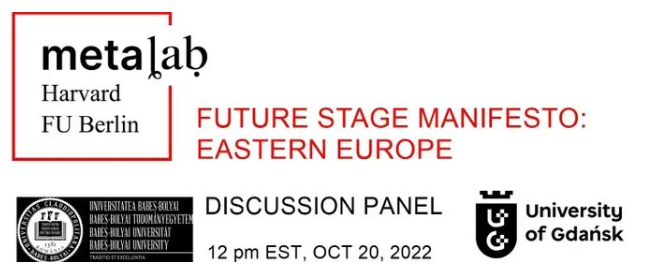
EVENT – FUTURE STAGE MANIFESTO
In October 2021, the futureStage research group published the Future Stage Manifesto, which has been translated and published in twelve languages, including Polish, Romanian, Hungarian, and Russian. This panel of international researchers and translators will discuss the impact of the Future Stage Manifesto on the Eastern European performing arts scene, and the opportunities it opens for transcultural collaborations, access, and political engagement. The panel will be moderated by metaLAB principal, Magda Romanska.
To participate, register here.
This event is co-organized with the Department of Performing Arts Studies at the University of Gdańsk in Poland, and Janovics Center for Screen and Performing Arts @ Babes-Bolyai University in Romania.
EVENT- Research Colloquium, October 6, 2022, Cinema Hall
SCREENING SOCIAL TRANSFORMATIONS
A research colloquium
10.00 – 11.00
Alasdair King, Queen Mary University of London
Film and political economy
11.00-12.00
Bogdan Popa, Transylvania University of Brașov
Sexuality and social criticism in Romanian film
15.00-16.00
Emanuel Copliaș, West University of Timișoara
A Hegelian approach to Romanian postcommunism
16.00-17.00 (online)
Laszlo Strausz and Balazs Varga, ELTE Budapest
Big data, small cinema: introducing a database-driven research on the social history of Hungarian cinema
EVENT – Feminist Film Heritage: Expanding the World’s Film Archives Call for Papers: Second Global Networking Symposium 5-7 Jan 2023
THEME: “Women’s Global Film Movements and Networks”
We warmly invite proposals from international scholars and practitioners with a specialism in the history of global cinema, for a second networking event in the context of the Feminist Film Heritage project, funded by the Royal Society of Edinburgh in Scotland. With the project we aim to map out and rediscover the neglected cultural histories of women’s work in early cinema. For this second event, we wish to focus on the histories, infrastructures and practices of women’s networks and movements around the world, which supported women creatives in multiple ways and contributed to the visibility and sustainability of their work and films. We particularly want to invite those with an interest in transnational women’s networks and movements connected to audiovisual practices, such as but not limited to: suffragette movements, the non-aligned movement, socialist and activist networks, film clubs, worker’s unions, various women’s associations and organisations, and film festival networks, which supported women creatives in film through networking opportunities, mentorship, career programmes, funding, formal and informal film collaborations, etc.
The two-year project, Feminist Film Heritage: Expanding the World’s Film Archives, aims to establish an international network of scholars working on decentring film history, and to do so by countering feminist film history’s continued neglect of filmmakers from outside Europe and the US. Hoping to give shape to fuller configurations of the internationalist feminist film movement, we highlight historically transnational networks and reactivate past alliances. With this project we want to make more visible the role of women and their films in the global film archives, establishing a collective of feminist world cinema historians. Bringing together disparate efforts to safeguard individual corpuses of film cultures and heritage, the researchers in this network envisage increased collaboration across borders. Better awareness of presences, absences, practices and methodologies will enable new collaborations between partners across borders.
This initiative is rooted in a desire to consider the diverse methodologies of decolonizing film history in an activist feminist way. We critique the continued Western European dominance of funding and infrastructure for these efforts (including our own). We address the (neo-)colonial history of archives, museums and festivals; the sense of “service” practiced by these institutions; and the (material and conceptual) ownership of artefacts and restorations. This network emphasises the roles of women filmmakers in history; the contributions of feminist scholars to film historiography; and the women workers shaping the structures on which the archival and preservation institutions are built.
The first event, which took place between 10 and 14 January 2022, organised by QMU in Edinburgh and funded by the Royal Society of Edinburgh, gathered over a hundred film practitioners, film historians, and archivists from around the world in an effort to map out existing work and seek out productive pathways towards collaboration. During the five-day global networking event, we were able to learn about national, family and personal archives and initiatives, and preservation facilities and professionals (such as the Pan-African Film Archive, the Albanian Film Archive, and family archives of black Latin American women’s films), and neglected films and filmmaker collectives from around the world (such as women’s third world cinema movement, and women’s networks and work within film clubs), and we were able to establish the grounds for collaborative networks with one another for further research.
This second collaborative networking event, organised by the Janovics Centre for Screen and Performing Arts Studies at the Faculty of Theatre and Film at Babeș-Bolyai University and funded by the Royal Society of Edinburgh, will take place 5-7 January 2023 in an online format to allow participation from scholars and practitioners around the world. Its principal aim is to continue and deepen discussions initiated at the first event, to welcome new research and forge connections among participants as well as to continue ongoing collaborations, in an effort to safeguard global women’s film heritage and make visible different cultural histories of women’s participation in cinema.
Please email the organiser, Dr Ana Grgic, on ana.grgic@ubblcluj.ro, with your proposal for a short, 10-minute presentation, indicating your interest and specialism and a short bio. Please send a 200-word summary of your research interests and 100-word bio, in order that we may organise presentations, focus groups, and networking sessions. Deadline: Monday 31 October 6pm GMT.
We really look forward to hearing from you!
The FFH Team: Dr Lizelle Bisschoff, Dr Ana Grgic and Dr Stefanie Van de Peer
EVENT – Janovics Center Book Talk: Terence McSweeney Black Panther (2018): A ‘defining moment’ for America or Just a Movie?”
Friday, May 27, 12pm, Zoom link: https://zoom.us/j/96382837488 Meeting ID: 963 8283 7488
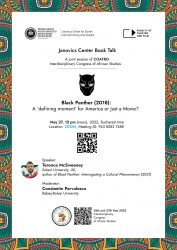
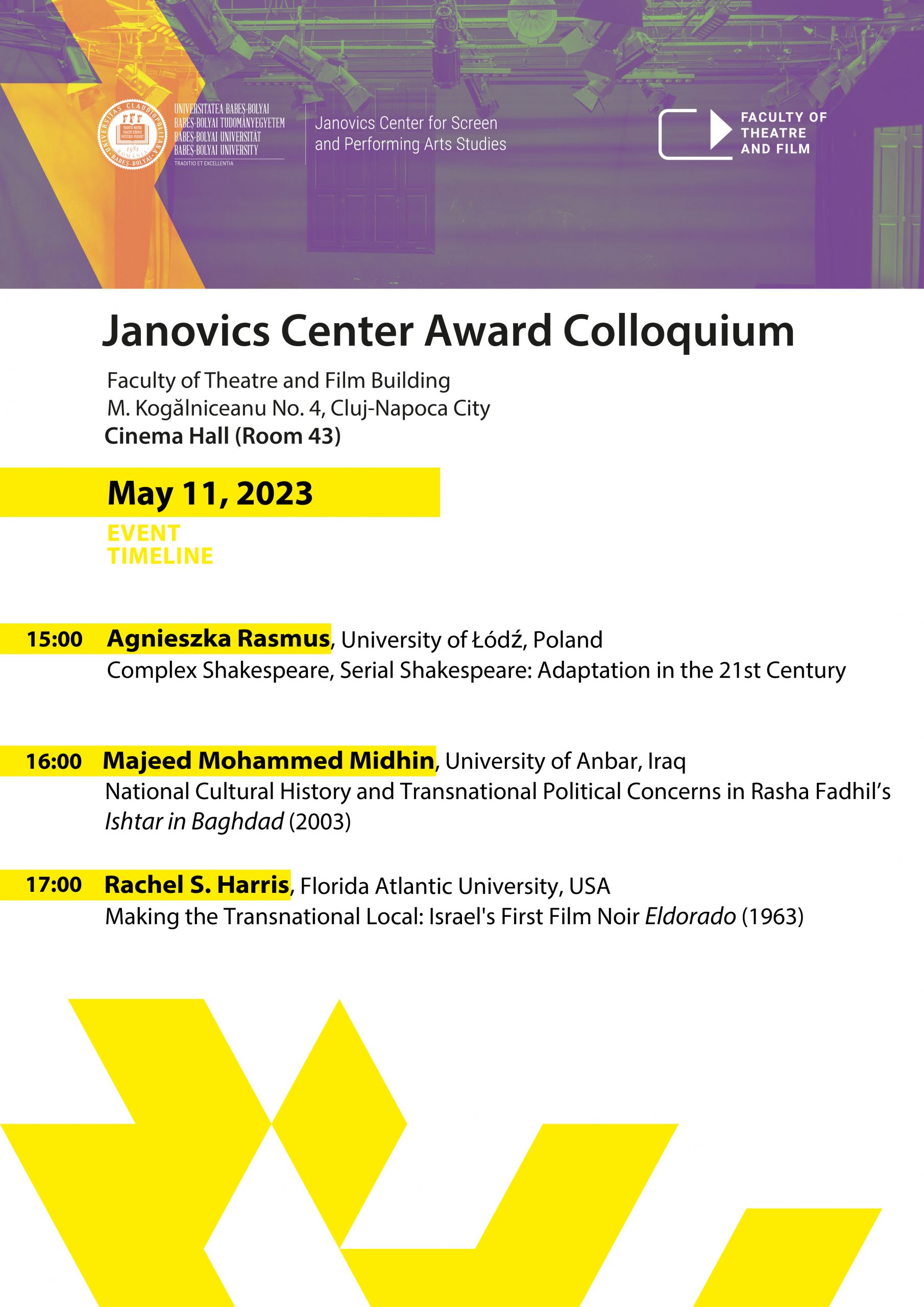
Event – Janovics Center Award Colloquium.
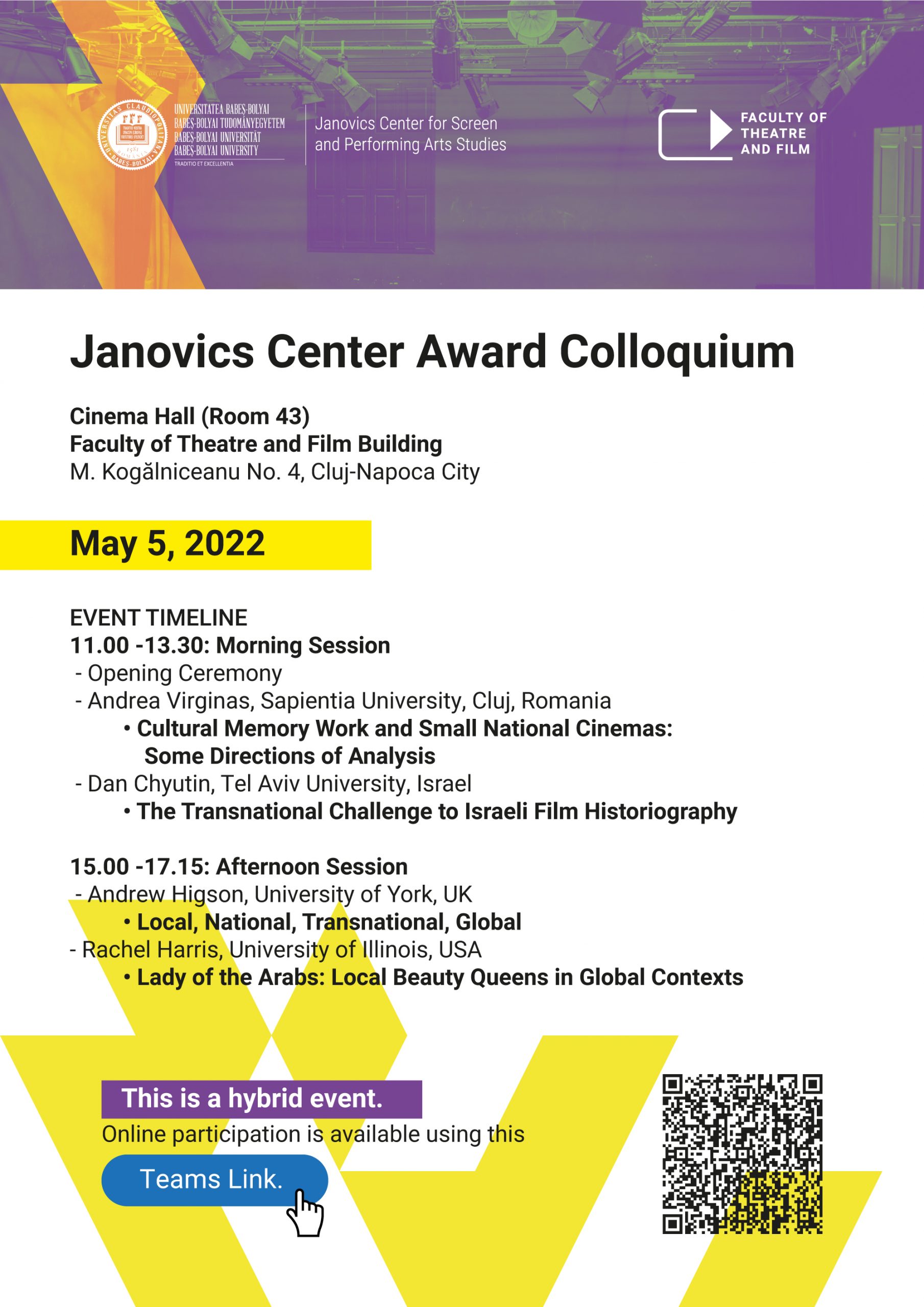
Janovics Center for Screen and Performing Arts Studies, Faculty of Theatre and Film, Babes-Bolyai University is delighted to invite you at the Janovics Center Award Colloquium on May 5, 2022. The event features the winners of The Janovics Center Award for Outstanding Humanities Research in Transnational Film and Theatre Studies.
The event takes place in the Cinema Hall (Room 43) of the Faculty of Theatre and Film Building. Online participation is available using this Teams Link.
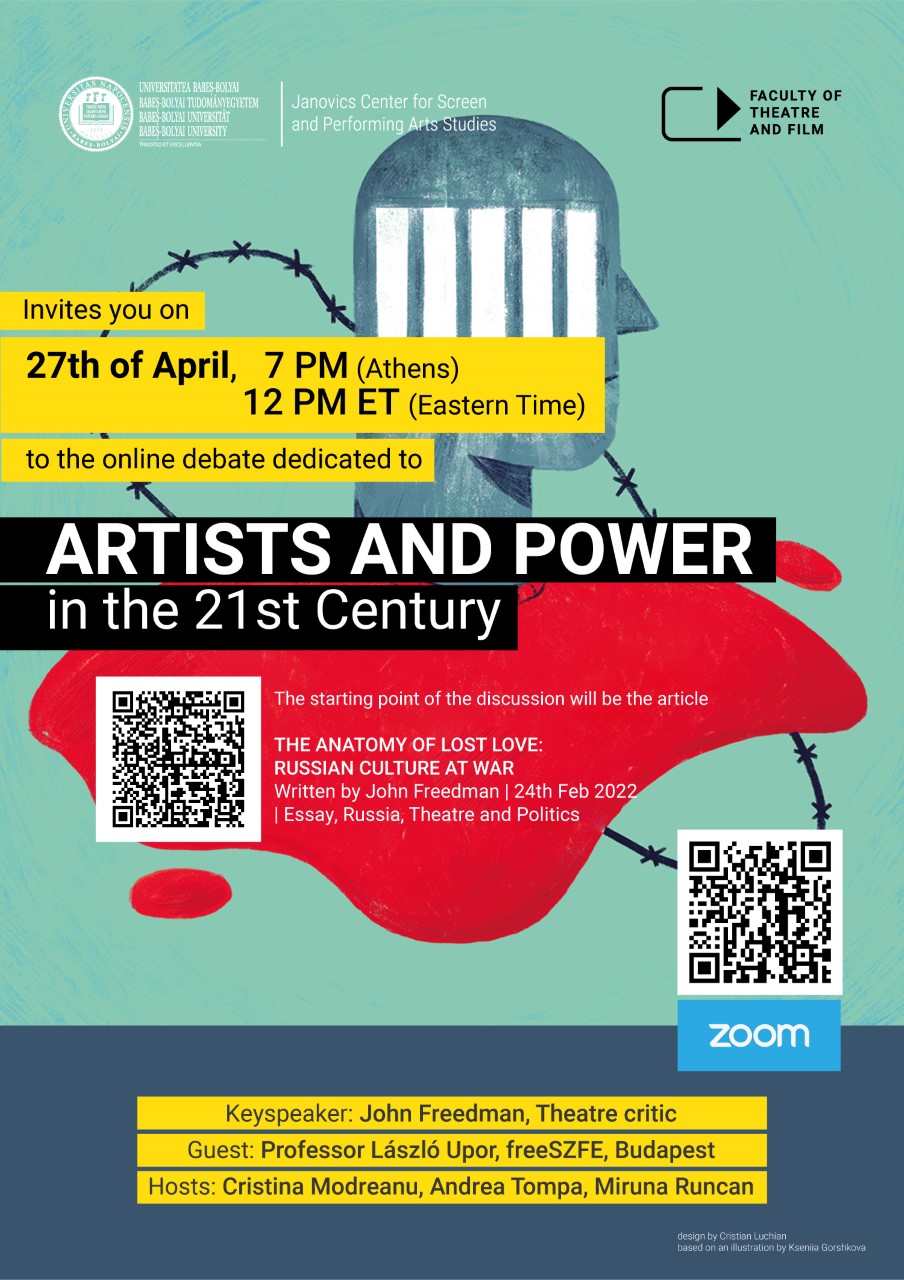
Event – Artists and Power in the 21st Century.
Determined by the war in Ukraine, therefore focused on an actual ( ) conflict, The Janovics Center for Screen and Performing Arts Studies invites theatre artists, theatre critics and academics to an online talk on the topic of Artists and Power in the 21st Century.
We have invited in this effect the American theatre critic John Freedman, a former resident of Moscow and an expert in Russian theatre and politics – as proved by his recent article The Anatomy of Lost Love: Russian Culture at War, the starting point of our debate. We have also invited our colleague, professor László Upor, freeSZFE, Budapest – former rector of the Theatre and Film Academy Budapest and a victim of political intervention since a couple of years ago.
The discussion, hosted by Cristina Modreanu, Andrea Tompa and Miruna Runcan, will take place Thursday 27 of April, 19 PM (Athens) /12 AM ET (Estern Time)
Link Zoom
Event – The Janovics Center Award for Outstanding Humanities Research in Transnational Film and Theatre Studies
Award Winners Announcement,
The Janovics Center Award for Outstanding Humanities Research in Transnational Film and Theatre Studies is yearly awarded to publications that advance transnational research in the fields of film and theatre studies and employ innovative methods in the humanities. The Jury awarding these works was composed of Professors Michael Gott, University of Cincinnati, Mariana Liz, University of Lisbon, and Constantin Parvulescu, Babes-Bolyai University (for film studies), and Liviu Dospinescu, Laval University Quebec, Péter P. Müller University of Pécs, and Miruna Runcan, Babes-Bolyai University (for theatre studies), decided to offer the following awards:
This year’s BEST BOOK award (monograph or collection) was offered to Rachel S. Harris and Dan Chyutin (eds), Casting a Giant Shadow: The Transnational Shaping of Israeli Cinema, Indiana University Press, 2021. The Jury commended the collection’s innovative, transnational approach to the study of a national cinema, the overall quality of its chapters and introduction, its comprehensive design, and the relevance of its intervention in the historiography of Israeli cinema.
This year’s BEST ARTICLE award was offered to Andrew Higson, “The Resilience of Popular National Cinemas in Europe (part one and two), Transnational Screens, 12:3, 2021, 199-219, 220-232. The Jury appreciated the extent, thoroughness, and relevance of the presented research, its interdisciplinary approach, and the way the work tackles major concepts in contemporary film studies, delivers a convincing defense of the concept of national cinema, and presents its findings in a clear and persuasive prose.
The Jury decided to offer a SPECIAL MENTION to Andrea Virginás, Film Genres in Hungarian and Romanian Cinema: History, Theory, and Reception, Lexington Books. 2021. The Jury recognized the ambitious objectives of the monograph, its contribution to understanding genre history, its comparative transnational method, and its insightful understanding of the cultural and industrial dynamics of small European film cultures.
The Janovics Center congratulates the authors for their achievements and will organize book presentations and talks related to their work. Further details on the award and related events are available on the Center’s website, under News and Events.
Cluj-Napoca, March 21, 2022.
Constantin Parvulescu and Miruna Runcan
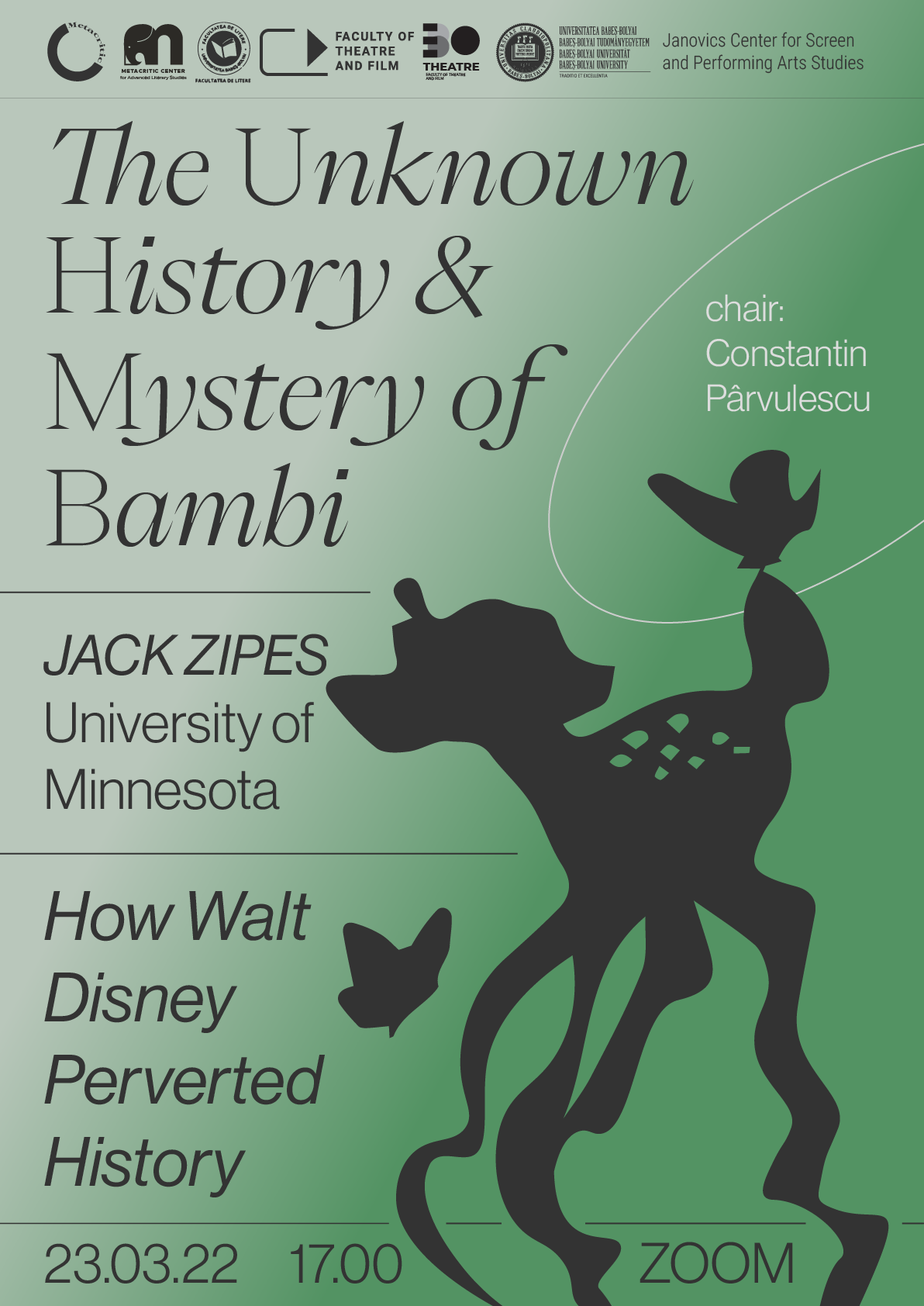
Event – The Unknown History and Mystery of Bambi: How Walt Disney Perverted History a talk by Jack Zipes
Wednesday, March, 23, 5pm (Bucharest time)
Join Zoom Meeting
https://zoom.us/j/96839292196?pwd=VHdjaXNPZ0doZjF2WEdZRTZjWlRmUT09
Event – How feminism is seen on the Romanian stage
An invitation to online debate
Friday / January 25th / 2022 / 6 PM
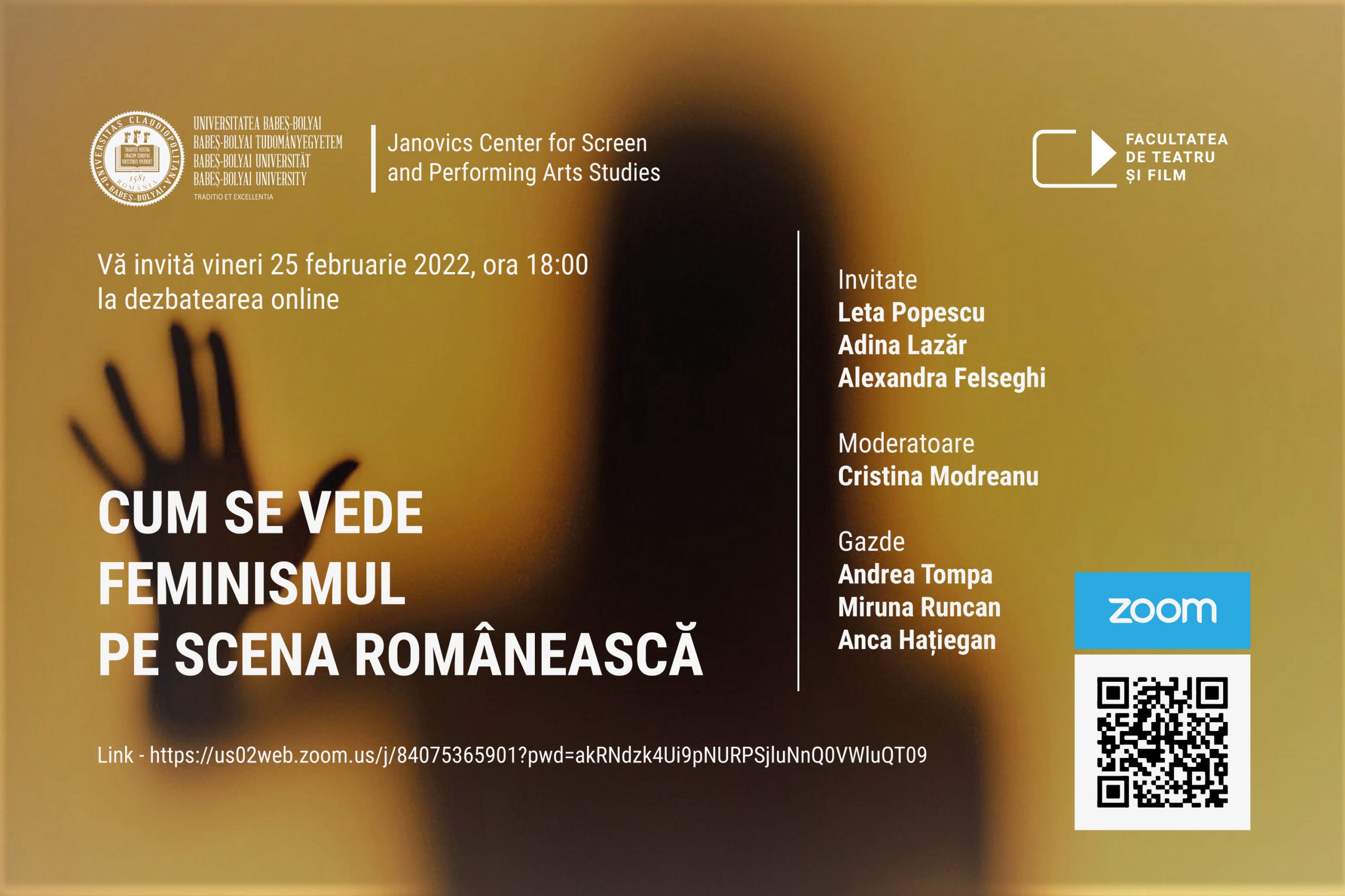
Despite the overwhelming challenges caused by the pandemic, the latest theatrical seasons have witnessed the coagulation of themes and artistic products related to the condition of women in today’s Romania. How deeply are they explored and what is the effect? We invite you to take part in an open and unbiased debate on this matter.
Guests: Leta Popescu, Adina Lazăr, Alexandra Felseghi
Moderator: Cristina Modreanu
Hosts: Andrea Tompa, Miruna Runcan, Anca Hațiegan
Location: ONLINE / ACCESS LINK
News – Jury: The Janovics Center Award for Outstanding Humanities Research in Transnational Film and Theatre Studies announces the jury for its film studies section:
Professor Michael Gott, Director of Film & Media Studies at the University of Cincinnati, editor and author of books on European and global film, including Screen Borders: From Calais to cinéma-monde (Manchester UP, 2022).
Professor Mariana Liz, School of Arts and Humanities, University of Lisbon, author of Euro-Visions: Europe in Contemporary Cinema (Bloomsbury, 2016) and Women’s Cinema in Contemporary Portugal (with Hilary Owen, Bloomsbury, 2020).
Professor Constantin Parvulescu, Director of The Janovics Center, Babes-Bolyai University, author of Orphans of the East: Eastern European Cinema and the Revolutionary Subject (Indiana University Press, 2015) and Global Finance on Screen (Routledge, 2018).
Event –January 10-14, 2022. Global Women’s Film Heritage: Networking Symposium.

News – Call for Submissions: The Janovics Center Award for Outstanding Humanities Research in Transnational Film and Theatre Studies
We invite submissions for our annual award for outstanding humanities research in transnational film and theatre studies. The award will be offered to contributions in the fields of film or theatre studies, books and articles.
The deadline for submissions is February 15, 2022.
News – Miruna Runcan’s book wins the PEN Award.
News – Janovics Center for Screen and Performing Arts Studies has joined the Hungarian Theater Department, Babeș-Bolyai University in organizing the conference
The Invisible History as Her Story. Women in Hungarian/Minority Theater.
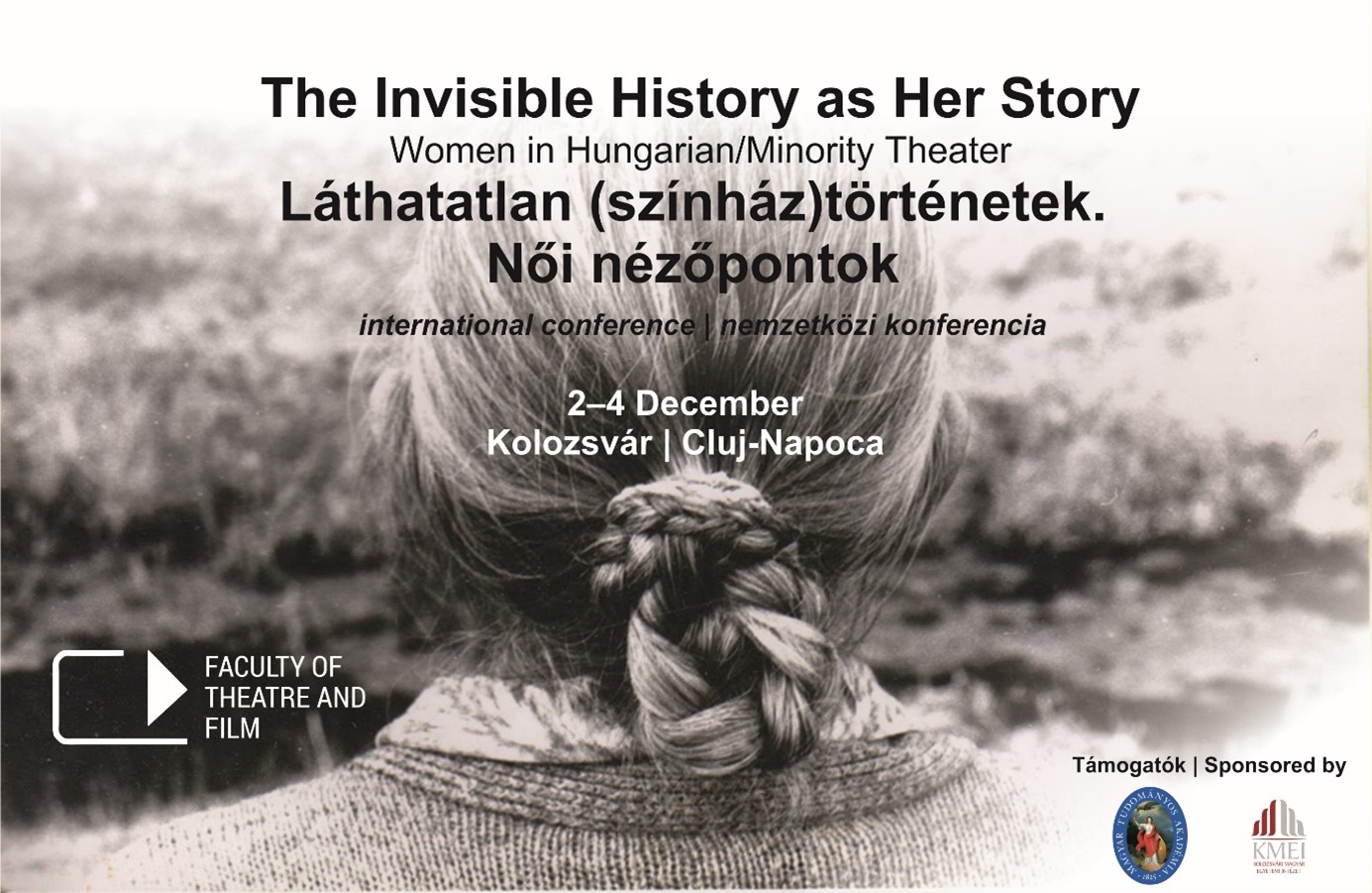
The conference takes place from 2nd to 4th of December in a hybrid format and it is supported by the Hungarian Academy of Sciences, the Hungarian University Institute of Cluj and the Babeș-Bolyai University.
The conference is bilingual, English and Hungarian, and interpreters will be provided for all presentations.
The Key Speakers are Gajdó Tamás (Hungarian Theater Museum and Institute), Penny Farfan (University of Calgary, Canada), Alina Nelega (University of Arts, Tirgu-Mures), Pető Andrea (Central European University, Hungary-Austria).
Four of the authors presenting papers in the conference are members of Janovics Center for Screen and Performing Arts Studies: Miruna Runcan, Andrea Tompa, Anca Hațiegan, Cristina Modreanu.
See the detailed program of the conference at the event link:
Event – Exploring East-Central European Screen Industries in Global Contexts with Petr Szczepanik
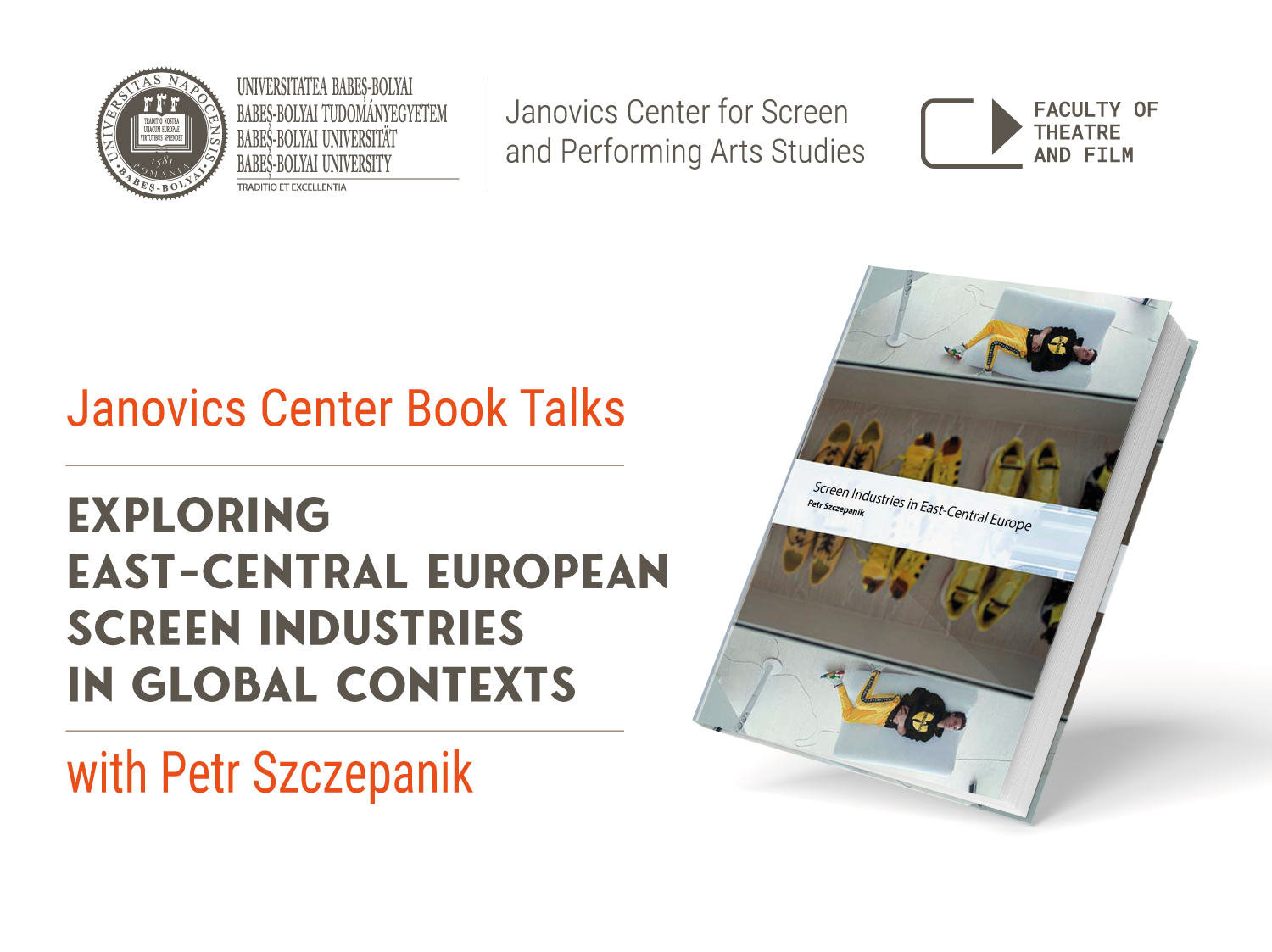
The Janovics Center for Screen and Performing Arts Studies organises a series of book talks with relevant authors from the industry. Audience is kindly invited on the 18th of November to meet Petr Szczepanik, author of Screen Industries in East-Central Europe.
This book provides an alternative perspective into the audiovisual and media industries of eastern and central Europe, namely the Czech Republic, Poland and Hungary. In doing so, it offers insight into the ways the screen industries of small nations are positioned in and respond to globalization and digitalization. Petr Szczepanik suggests that for these ‘digital peripheries’, globalization and digitalization are as yet incomplete, stumbling processes, closely intertwined with and mediated by deeply local circumstances and players.
Instead of a top-down economic or political overview, this book places central focus on the lived realities of producers as key initiators, facilitators, and cultural intermediaries. Drawing on in-depth interviews, it looks closely at how their agency is circumscribed by the limited scale and peripheral positioning of the markets in which they operate, and how they struggle to come to terms with these constraints through their business strategies, creative thinking and professional self-perceptions.
Moderated by professor Claudiu Turcuș, the talk titled Exploring East-Central European Screen Industries in Global Context, will be held online at 4.00 pm on 18th of November on zoom link: https://zoom.us/j/97017691384?pwd=NUplMUcvdm92dWl5bFVGb2tCTHlwZz09
The book is available as open access through the Bloomsbury Open programme and can be downloaded from www.bloomsburycollections.com.
Event – The Janovics Center for Screen and Performing Arts invites young and senior researchers, academics, and students to the debate-seminar
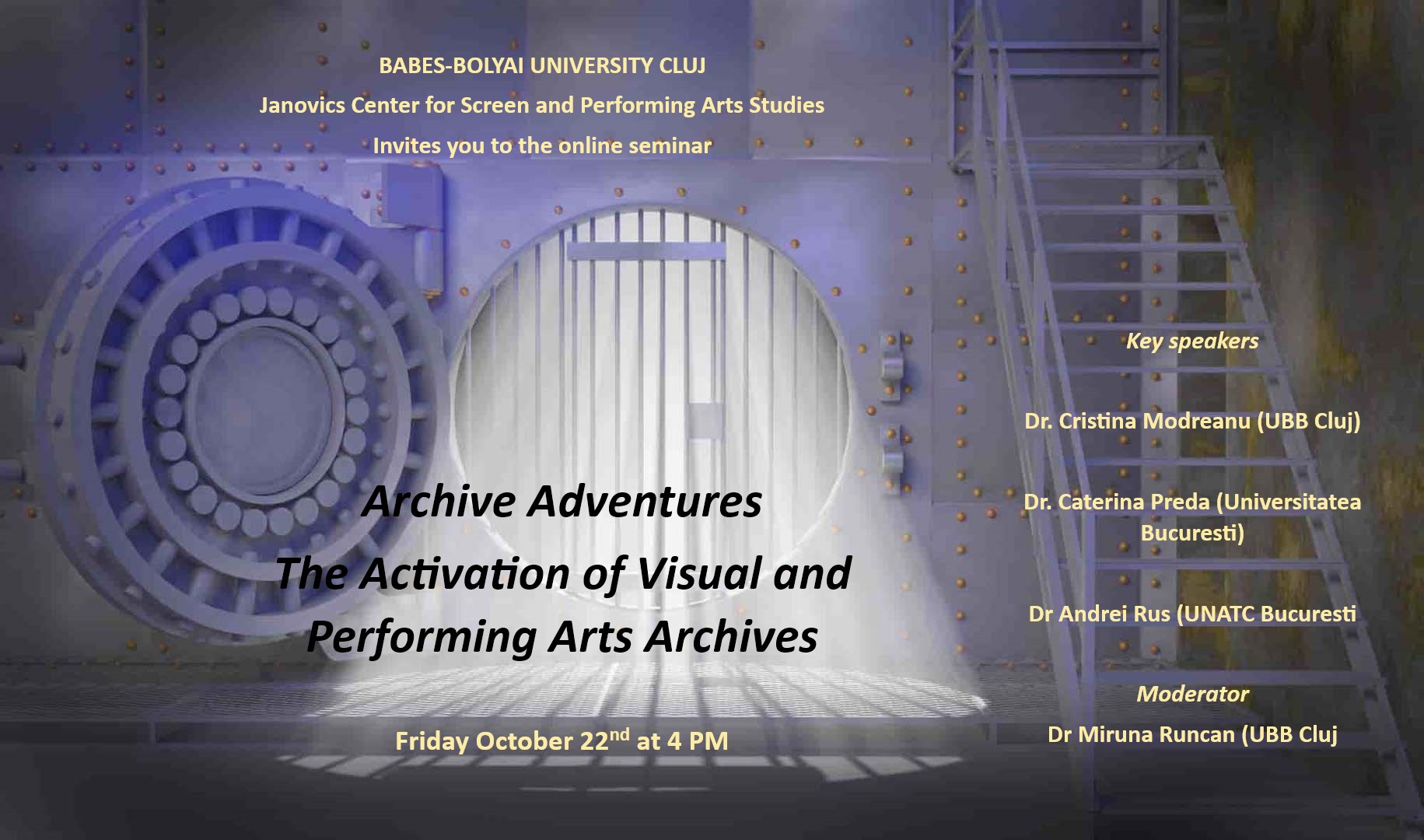
Archive Adventures: The Activation of Visual and Performing Arts Archives
The event will take place online, 22 October 2021, from 4 PM UTC+2.
Key Speakers:
Dr Caterina Preda, Associate Professor FSP Bucharest University
Dr. Cristina Modreanu, theatre critic, Researcher at Janovics Center for Screen and Performing Arts, Babes-Bolyai University
Dr. Andrei Rus, Associate Professor UNATC Bucharest
Moderator:
Dr. Miruna Runcan, Janovics Center for Screen and Performing Arts
Event – ROUNDTABLE DISCUSSION WITH THE ARTIST ORLAN

Wednesday, October 6, 6pm (Bucharest time)
Watch live here:
Guests:
· Horea Avram – Critic de artă, curator, Conferențiar Universitar la Facultatea de Teatru și Film a Universității Babeș-Bolyai, Cluj-Napoca (moderator)
· Ioana Costaș – Directoarea delegată a Institutului Francez din România la Cluj-Napoca
· Bogdan Ghiu – Scriitor, eseist, traducător
· Laura T. Ilea – Scriitoare, eseistă, Lector universitar la Facultatea de Litere a Universității Babeș-Bolyai, Cluj-Napoca
· Călin Stegerean – Eseist, artist, Directorul General al Muzeului Național de Artă al României
· Florin Ștefan – Artist, Profesor la Universitatea de Artă și Design Cluj, Președintele Federației Centru de Interes
· Yann Toma – Artist și cercetător, Profesor de arte vizuale la Universitatea Sorbona din Paris
Event – Seminar hosted by Janovics Center for Screen and Performing Arts Studies
THURSDAY 30 SEPTEMBER
17:00 – 18:00 (ONLINE – ZOOM MEETING)
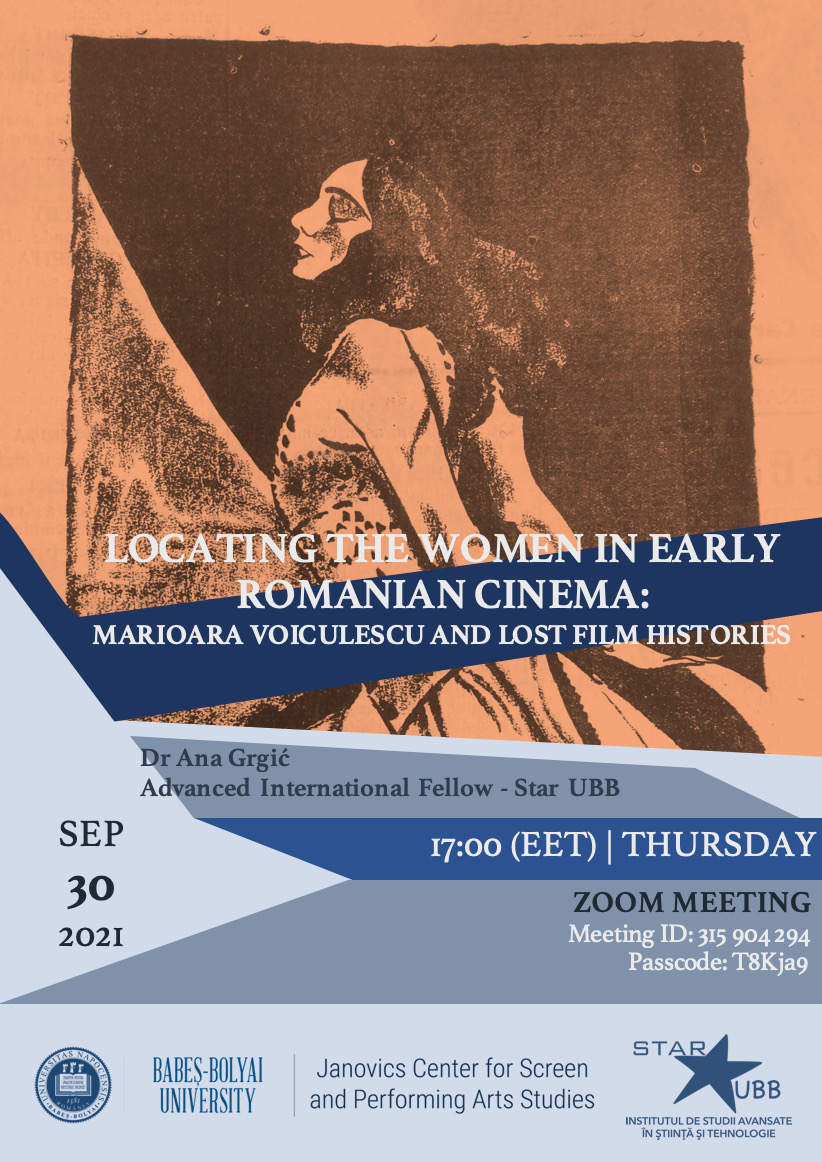
LOCATING THE WOMEN IN EARLY ROMANIAN CINEMA: MARIOARA VOICULESCU AND LOST FILM HISTORIES
by Dr Ana Grgić (Advanced International Fellow – Star UBB)
The seminar will be held online via Zoom, and followed by a Q&A.
Join Zoom Meeting
https://zoom.us/j/3159042949?pwd=bHczd3pQNmIxUVcyQmFIb1paUi9aUT09
Meeting ID: 315 904 2949
Passcode: T8Kja9
News – Ana Grgic and Constantin Parvulescu will serve on the official selection juries of ASTRA International Documentary Film Festival Sibiu, September 5-12, 2021 https://www.astrafilm.ro/en/jury-2021
News – In May 2021 Romanian Association for Performing Arts (ARPAS) received the AFCN Award for ”Reviving the Immaterial Heritage” for the project The Multimedia Dictionary of Romanian Theatre- DMTR.ro, project leader Cristina Modreanu.
News – Professor Miruna Runcan was awarded the prestigious Best Critic Award at UNITER’s Gala in July 2021.
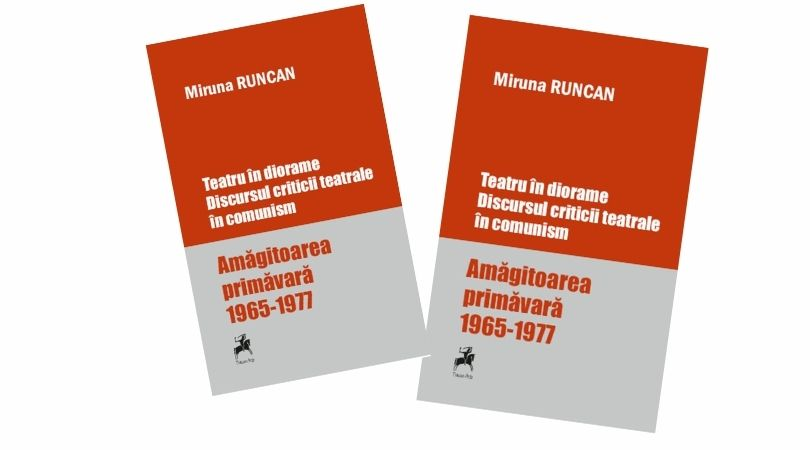
News – Professor Miruna Runcan was nominated for the “Literary Criticism/Literary History/Literary Theory Award” by Observator Cultural 2021 for her book Teatru în diorame. Discursul criticii de teatru în comunism. Amăgitoarea primăvară 1965-1977, (Theatre Criticism Discourses in Communist Era – 1965-1977), Tracus Arte, 2020.
News – Ana Grgić was awarded the New Europe College International Fellowship for the research project “Rediscovering a lost female film pioneer: Mărioara Voiculescu and early cinema in Romania and the Balkans” starting October 2021.
News – Cristina Modreanu will join the Theatre Department of UBB as an affiliate researcher starting October 2021.
Event – Romanian Theatre Heritage: A Dictionary for the next generations
We are excited to announce that The Multimedia Dictionary of Romanian Theatre -DMTR.ro will be presented in the frame of the National Theatre Festival in October 2021 on the occasion of the uploading of the 100th dictionary entry.
The occasion will be marked by introductions made by three of the researchers who have been actively involved with the construction of the Multimedia Dictionary, the project leader, Dr. Cristina Modreanu (researcher, UBB), the senior researcher and students coordinator Dr. Miruna Runcan (professor, Theatre Department, UBB) and theatre critic and producer Oana Cristea Grigorescu.
We will keep you updated on the exact day and hour and you are invited to join us on the celebration of this event..